![SocioPatterns [logo]](http://www.sociopatterns.org/wp-content/themes/sp2/images/header_logo.png)



DATASETSThis page provides a collection of datasets obtained through the SocioPatterns sensing platform. Contact patterns in a village in rural MalawiRelease data: Sep 11, 2021
The data set contains observational contact data collected for 86 individuals living in a village in rural Malawi. These data were analyzed and published in the paper L. Ozella et al., “Using wearable proximity sensors to characterize social contact patterns in a village of rural Malawi”, EPJ Data Science 10, 46 (2021). Baboons’ interactionsRelease data: Dec 4, 2020
The data set contains observational and wearable sensors data collected in a group of 20 Guinea baboons living in an enclosure of a Primate Center in France, between June 13th 2019 and July 10th 2019. These data were analyzed and published in the paper V. Gelardi, J. Godard, D. Paleressompoulle, N. Claidière, A. Barrat, “Measuring social networks in primates: wearable sensors vs. direct observations”, Proc. R. Soc. A 476:20190737 (2020). ## OBS DATA ## SENSOR DATA Co-location data for several SocioPatterns data setsRelease data: Dec 4, 2018
We are releasing complementary data with respect to the face-to-face contact data released previously. For a series of cases, we consider, as described in the publication Can co-location be used as a proxy for face-to-face contacts?, the information on which RFID readers received information from the RFID tags. Namely, we define two individuals to be in co-presence if the same exact set of readers have received signals from both individuals during a 20s time window. We release here 6 co-presence data sets. The contexts in which these data were collected are: a workplace, with data collected in two different years (InVS13, InVS15), a hospital (LH10), a primary school (LyonSchool), a scientific conference (SFHH) and a high school (Thiers13). In each case, the data on face-to-face contacts during the same timeframe has already been released. In all cases except SFHH, metadata is also available concerning the department, class or status of each individual. All the data are also Supplementary Material of the publication Can co-location be used as a proxy for face-to-face contacts? Files: – co-presence.tar.gz contains all six co-presence networks. Both contacts and co-presence data are formatted as tij, i.e. each line represents a contact occurring at a time t between two nodes i and j. – metadata.tar contains the lists of nodes, with the first column being the node identifier and the second the group affiliation, when available. SFHH conference data setRelease data: Dec 3, 2018
This data set describes the face-to-face interactions of 405 participants to the 2009 SFHH conference in Nice, France (June 4-5, 2009). It was first described in the publications Dynamics of Person-to-Person Interactions from Distributed RFID Sensor Networks and Simulation of an SEIR Infectious Disease Model on the Dynamic Contact Network of Conference Attendees. It was released as supplementary data set of the publication Can co-location be used as a proxy for face-to-face contacts? The data file is in the usual format representing the active contacts during 20-second intervals of the data collection. Each line has the form “t i j”, where i and j are the anonymous IDs of the persons in contact, and the interval during which this contact was active is [ t – 20s, t ] (t is expressed in seconds). Contacts in a workplace, 2nd deploymentRelease data:
This data set contains the temporal network of contacts between individuals measured in an office building in France in 2015. This network was described and analyzed in the publication Can co-location be used as a proxy for face-to-face contacts? The data set comprises two files. The first one contains a space-separated list representing the active contacts during 20-second intervals of the data collection. Each line has the form “t i j”, where i and j are the anonymous IDs of the persons in contact, and the interval during which this contact was active is [ t – 20s, t ] (t is expressed in seconds). Contacts in a workplaceRelease data: Jun 23, 2016
This data set contains the temporal network of contacts between individuals measured in an office building in France, from June 24 to July 3, 2013. This network was described and analyzed in the publication “Data on face-to-face contacts in an office building suggest a low-cost vaccination strategy based on community linkers” by M. Génois et al., published as Network Science 3, 326 (2015). Kenyan households contact networkRelease data: Jun 20, 2016
This dataset contains the full list of contacts measured between members of 5 households of rural Kenya between April 24 and May 12, 2012. Results from the analysis of this dataset have been published in EPJ Data Science, 5(1), 1-21 (2016). Each file in the downloadable package contains a comma-separated list representing each measured contact between any two household members (member 1 and member 2) over three days of experiment. The first file stores the contacts recorded between members of the same household, the second file stores the contacts between members of different households. Each line has the form: “h1, m1, h2, m2, age1, age2, sex1, sex2, duration, day, hour”, where:
A more detailed description of the variables is available in the variable dictionary file.
Primary school temporal network dataRelease data: Sep 30, 2015
This data set contains the temporal network of contacts between the children and teachers used in the study published in BMC Infectious Diseases 2014, 14:695. The file contains a tab-separated list representing the active contacts during 20-second intervals of the data collection. Each line has the form “t i j Ci Cj”, where i and j are the anonymous IDs of the persons in contact, Ci and Cj are their classes, and the interval during which this contact was active is [ t – 20s, t ]. If multiple contacts are active in a given interval, you will see multiple lines starting with the same value of t. Time is measured in seconds. High school contact and friendship networksRelease data: Jul 15, 2015
These data sets correspond to the contacts and friendship relations between students in a high school in Marseilles, France, in December 2013, as measured through several techniques. -The first data set gives the contacts of the students of nine classes during 5 days in Dec. 2013, as measured by the SocioPatterns infrastructure. The file contains a tab-separated list representing the active contacts during 20-second intervals of the data collection. Each line has the form “t i j Ci Cj“, where i and j are the anonymous IDs of the persons in contact, Ci and Cj are their classes, and the interval during which this contact was active is [ t – 20s, t ]. If multiple contacts are active in a given interval, you will see multiple lines starting with the same value of t. Time is measured in seconds and expressed in UNIX ctime. -The second data set corresponds to the directed network of contacts between students as reported in contact diaries collected at the end of the fourth day of the data collection. Each line has the form “i j w”, meaning that student i reported contacts with student j of aggregate durations of (i) at most 5 min if w = 1, (ii) between 5 and 15 min if w = 2, (iii) between 15 min and 1 h if w = 3, (iv) more than 1 h if w = 4. -The third data set corresponds to the directed network of reported friendships. Each line has the form “i j”, meaning that student i reported a friendship with student j. -The fourth data set corresponds to the list of pairs of students for which the presence or absence of a Facebook friendship is known. Each line has the form “i j w”, where w=1 means that students i and j are linked on Facebook, while w=0 means that they are not. -Finally the metadata file contains a tab-separated list in which each line of the form “i Ci Gi” gives class Ci and gender Gi of the person having ID i. High school dynamic contact networksRelease data: Aug 24, 2014
These datasets contain the temporal network of contacts between students in a high school in Marseilles, France. The first dataset gives the contacts of the students of three classes during 4 days in Dec. 2011, and the second corresponds to the contacts of the students of 5 classes during 7 days (from a Monday to the Tuesday of the following week) in Nov. 2012. Each Contact list file contains a tab-separated list representing the active contacts during 20-second intervals of the data collection. Each line has the form “t i j Ci Cj“, where i and j are the anonymous IDs of the persons in contact, Ci and Cj are their classes, and the interval during which this contact was active is [ t – 20s, t ]. If multiple contacts are active in a given interval, you will see multiple lines starting with the same value of t. Time is measured in seconds (for the 2012 data, it is expressed in UNIX ctime). Each metadata file contains a tab-separated list in which each line of the form “i Ci Gi” gives class Ci and gender Gi of the person having ID i. Hospital ward dynamic contact networkRelease data: Sep 14, 2013
This dataset contains the temporal network of contacts between patients, patients and health-care workers (HCWs) and among HCWs in a hospital ward in Lyon, France, from Monday, December 6, 2010 at 1:00 pm to Friday, December 10, 2010 at 2:00 pm. The study included 46 HCWs and 29 patients. The file contains a tab-separated list representing the active contacts during 20-second intervals of the data collection. Each line has the form “t i j Si Sj“, where i and j are the anonymous IDs of the persons in contact, Si and Sj are their statuses (NUR=paramedical staff, i.e. nurses and nurses’ aides; PAT=Patient; MED=Medical doctor; ADM=administrative staff), and the interval during which this contact was active is [ t – 20s, t ]. If multiple contacts are active in a given interval, you will see multiple lines starting with the same value of t. Time is measured in seconds.
Infectious SocioPatterns dynamic contact networksRelease data: Nov 28, 2011
This dataset contains the daily dynamic contact networks collected during the Infectious SocioPatterns event that took place at the Science Gallery in Dublin, Ireland, during the artscience exhibition INFECTIOUS: STAY AWAY. Each file in the downloadable package contains a tab-separated list representing the active contacts during 20-second intervals of one day of data collection. Each line has the form “t i j“, where i and j are the anonymous IDs of the persons in contact, and the interval during which this contact was active is [ t – 20s, t ]. If multiple contacts are active in a given interval, you will see multiple lines starting with the same value of t. Time is measured in seconds and expressed in UNIX ctime. This dataset is the dynamic counterpart of the daily cumulated contact networks available here. Hypertext 2009 dynamic contact networkRelease data: Oct 28, 2011
This dataset was collected during the ACM Hypertext 2009 conference, where the SocioPatterns project deployed the Live Social Semantics application. Conference attendees volunteered to wear radio badges that monitored their face-to-face proximity. The dataset published here represents the dynamical network of face-to-face proximity of ~110 conference attendees over about 2.5 days. No personal data are released here, and no metadata collected by the Live Social Semantics application are exposed. We provide two data files, described below. Contact List. This is a tab-separated list representing the active contacts during 20-second intervals of the data collection. Each line has the form “t i j“, where i and j are the anonymous IDs of the persons in contact, and the interval during which this contact was active is [ t – 20s, t ]. If multiple contacts are active in a given interval, you will see multiple lines starting with the same value of t. Time is measured in seconds since 8am on Jun 29th 2009 (UNIX ctime 1246255200). Contact Intervals. This file is in JSON format and contains a dictionary. Each key is a person ID and the corresponding value is a dictionary of neighbors of that person in the contact network. This dictionary of neighbors has person IDs as keys and, for each key, the value gives the list of time intervals during which the corresponding contact was active. Time is measured as above.
Primary school – cumulative networksRelease data: Aug 27, 2011
Infectious SocioPatternsRelease data: Mar 31, 2011
For more details on the data collection and processing please see our paper What’s in a crowd? Analysis of face-to-face behavioral networks.
|
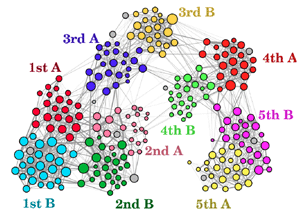 This dataset is part of our study of contact networks in a primary school, as reported in the paper
 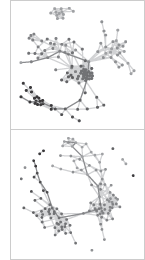 This first dataset contains the daily cumulated networks represented in the
   |
![SocioPatterns [logo]](http://www.sociopatterns.org/wp-content/themes/sp2/images/footer_logo.png) |